Please ensure Javascript is enabled for purposes of website accessibility

Category: Boss Blog

  • My Why

    My Why

    Writer’s block is real. Until about six months ago, blogs came fairly easily and there was a formula. I’d tell a story. Then I would make an analogy. I’d try to conclude in a logical way with some guidance, advice, or even just an observation. Then, for no reason at all, it became really hard to write. 

    It wasn’t that I had trouble saying what I needed to say. It was that I was having a remarkable amount of trouble saying what I had to say concisely. My thoughts became pages rather than paragraphs. They wandered all over the spectrum. I was trying to say everything, all at once. Sometimes, I found myself trying to justify my point, knowing that it could be hard to swallow coming from the person in charge of reporting the numbers. 

    I took some time to contemplate why that might be the case. I arrived at the conclusion that in every instance I was trying to communicate my motivation as much as I was trying to communicate my point. For some reason, I didn’t believe that people would understand my “why”. Why would the Director of Business Intelligence write about anything if the intent wasn’t to drive stats? Would people wonder if this was just another swing at improving productivity? I’d like to resolve those questions. 

    When I first started as a rehab tech at Ingall’s Memorial Hospital in 1994, Physical Therapy was the career of choice for all the reasons. I have watched the profession move from an elite career choice to a calling. I am not exaggerating when I say I have the highest respect for the professionals of today who, as exceptional students, choose a path to a doctoral degree that does not come with the financial rewards or other benefits that the same level of education might have provided in another field. But with a passion for the profession and the ability to impact lives at an extremely tangible level, you chose it. You have my deepest admiration and gratitude for continuing to make Physical Therapy what it is today. 

    There are millions of people who benefit from the services we provide as therapists. We are the definitive experts in muscles, joints, nerves, and movement (among many other specialties). People need Physical Therapy. It literally improves their lives. 

    When I think about all the things we measure and why we report on them, I remember this: there are people who have made life-altering choices to provide Physical Therapy to those around their community. There are also people who require Physical Therapy to optimize the life they live. The goal of my work is to help people connect those dots as many times as possible in the best possible way. 

    In the process of doing this, we measure so many things, and sometimes the impact can get lost. Organizationally, the objective is the same. Regardless of your position, our cumulative work affects the ability of people to efficiently access the care they need. 

    Eval wait days measure how long someone in pain needs to wait to see someone who can help them not hurt. Drops are a measure of how many times we could have helped someone but didn’t have that chance. Units per Visit help put a number on the comprehensive nature of the care we deliver. 

    Our services are valuable on both sides of the equation and should be respected as such. Revenue growth supports access growth. The list is endless. The story is the same, but the story does not end in the clinic. 

    Central Insurance Verification makes sure the people about to receive care will not be unpleasantly surprised later by a non-covered service or provider. The front office helps people negotiate the landscape of insurance as well as working tirelessly to align schedules to connect people with the care they need. Billers make sure that services are billed in a timely way so that the financial component of care does not linger long after the patient is better. IT never sleeps, impacting every part of the daily process. 

    Teams of individuals in Growth, Marketing, Finance, HR, Accounting, Operations, Compliance, Credentialing, and Legal handle the nuances of their respective departments that are too complex to list here. All of them do what they do so that we can connect people who do Physical Therapy with the people who need Physical Therapy. 

    My Why

    This all leads back to my “why”. People doing the work of delivering care deserve clear and timely feedback on how effectively those connections are being made. They deserve metrics on the patient’s experience before, during, and after care so they can make meaningful decisions toward improvement or so that they can celebrate when it’s done in an exceptional way. 

    If you have your own motivating “why”, please pursue it with passion…and share it. If you don’t? If you feel like somehow the industry has become compressed with too many metrics and has lost its heart? I encourage you to borrow my “why” for a bit. I believe you’ll find your own in short order, but I’m also confident that as you approach your workday, it’s undeniably motivating to know we’re working together to build lasting connections between people who provide this valuable service and the people who need it most.
  • Boss Blog: Plain Cheese?

    Boss Blog: Plain Cheese?

    My future daughter in law, Morgan, is a Board Certified Behavioral Analyst. She uses Applied Behavior Analysis to create interventions and plans that result in positive behavioral change. She’s thoughtful, intelligent, and great at her job. Behavioral change is a complex topic, and I have a lot to learn from her. Well before she was certified, though, Morgan was teaching me about my own behavior. It’s just that at the time, neither of us knew it.

    One of the first few times Morgan joined our family for dinner, we went casual and ordered pizza. Not knowing her preference, we just ordered some supreme and some peperoni as those two choices cover a lot of bases. Without any complaints, Morgan took a couple slices of the pepperoni pizza. She delicately picked off the pepperoni slices and set them aside. Then she ate the remainder.

    A couple of months later, we ordered pizza again. This time we made sure to order a plain cheese pizza that was specifically for Morgan. She was very kind and gracious as she always is, and she ate the cheese pizza instead of the supreme. 

    After about a year of this, it came up in conversation that Morgan prefers plain cheese on her pizza. She replied, “I actually prefer bacon, and sometimes meat lover’s.” When we finally got down to discussing it, she just didn’t like the veggies and mushrooms on a supreme. And as for why she picked off the pepperoni during that first meal, it was because she liked the taste that the pepperoni left on the pizza, but found the pepperoni slices themselves too greasy. 

    For a year, we had been making a decision for Morgan without ever discussing it with her. She just went with it because she just assumed we typically ordered plain cheese pizza, and between that and supreme, plain was her preference. We wouldn’t hesitate to order anything for her. We wanted her to have exactly what she wanted and the best that the pizza place has to offer. But she was always left with the plain results of my choice because she wasn’t involved in the choice.

    The Opportunity Cost of Assumptions

    I think back on my time as a clinic director and can easily point to times when I could have been better at not making choices for people. I assumed copays or deductibles were too expensive for patients to schedule three appointments per week. I assumed family obligations were too complicated to offer specific appointment times that patients would have preferred. I assumed they were too tired to push harder or, more often, that they were doing well enough to be done altogether.

    In short, people ate cheese pizza because that’s what I served. There was a chance to sit down and say “Here’s what I think is the best.  Knowing that, what do you think is best for you?” Then people could have been left to make an individual decision about their own care that was not only informed, but also one that worked for their individual priorities. 

    We shouldn’t be making assumptions about people’s preferences. We shouldn’t be making their financial decisions for them. We shouldn’t limit access to services we offer because of our biases. We provide an incredibly valuable service, but sometimes we’re the first in line to devalue it by making decisions for people who want to access that care. 

    Only our patients know their whole story. Morgan enjoyed the pizza she had and the time she spent with us at dinner. She would have likely enjoyed it more if she got to choose from everything the restaurant had to offer. She ate pizza that was less than it could have been because I decided what she wanted based on assumptions instead of collaboration. 

    This year, show your patients the whole menu. Don’t limit their experience to plain cheese. Don’t make their decisions for them. Give them all the information, then work with them to maximize that value. 

  • PT Patient Expectations in an AI World 

    PT Patient Expectations in an AI World 

    I love reading patient comments. There are so many instances of positive feedback, which affirms that we’re doing what we do with a level of professional excellence that our patients didn’t anticipate. There are occasional comments that discuss areas for improvement (and those should be cherished as well), but overall, the feedback we receive is reflective of a delivery of care that goes far beyond each patient’s expectations from treatment. 

    But I have no idea how we’ll manage expectations in the future.

    Changing expectations with new technology

    I’ve written recently about the impact of AI on our workflows and practice. We’ve all considered what AI can do in terms of acting as a tool for improved efficiency and potentially even better care. It will impact so many tasks and daily routines. There’s no question about that. But it will also inevitably impact patient experience. 

    Consider these scenarios: 

    • A recent graduate comes in with knee pain from training for a marathon. She has the latest smart watch and she closes her circles every day. She expects online scheduling and wants her home exercises texted to her phone. Then she expects that the exercises will seamlessly integrate with her fitness tracker to maximize compliance and feedback. 
    • A factory worker was laid off when his plant was fully automated. He never used computers before having to apply for healthcare coverage in the marketplace. Getting connected with his physician was a struggle. Appointment reminders came through text, but he felt frustrated that he wasn’t actually connected to a person on the other end. When being seen for his evaluation, he breaks down when he’s asked to repeat the information that he’s already entered into five different forms prior to arrival. 
    • An elderly woman arrives following shoulder surgery. She sees the excitement of a younger patient utilizing her smart watch and phone to confirm and track plan of care details. She says she wants all the “bells and whistles” of fitness tracking and electronic access to visit notes and plans. Then she reveals her antiquated phone that may not be compatible with any of your clinic’s software or tools and asks you to show her how it all works. 

    At the desk, on the phone, in the gym, or online, we are going to have to understand each of these points of view if we intend to continue to deliver care that exceeds expectations. Technology is going to be an incredible tool, but it will also come with challenges that never existed prior to this moment in time. 

    Our response as clinicians

    Our clinics will grapple with widening socioeconomic divides within our communities. People may have access to modern care without being able to afford or understand the tools for accessing it once they leave the facility. People may want the most advanced decision-making available but will also be hesitant to trust an algorithm over a person. Patients may demand the most current technologies and conveniences and will not understand that the pace of AI adoption in healthcare systems isn’t the same as the pace of adoption in software companies. 

    As a profession, we’ve always been excellent at continuing to learn. We take courses on shoulder movement and back pain. We learn about neuroscience and kinesiology. My impression is that the exceptional therapists in the next decade will work extremely hard at intentionally refining listening skills and communication. They’ll also remain adaptable in terms of how to deliver high-quality care in multiple ways.   

    Regardless of your role, you will undoubtedly come across people at every stage on this technological path. From flat-out rejection to full immersion, we have a responsibility to each patient to meet them right where they are and deliver care accordingly. We understand the potential of the destination. It makes sense for us to be the ones to establish that initial common ground. 

    AI isn’t a replacement. It’s an enhancement. As it frees up our resources and improves our connection to the evidence, we won’t have tons of newfound free-time. We have an opportunity to reinvest those gains into actively connecting with our patients. We can do more than participate on an interventional level that addresses their dysfunction. We need to connect at a personal level that allows them to access our professional excellence on a level playing field, regardless of technological advantage. 

  • Boss Blog: Integrating AI into PT Care Delivery

    Boss Blog: Integrating AI into PT Care Delivery

    By Eric Boss, PT, MBA

    I’ve been a Physical Therapist for twenty-five years. My career has evolved into working primarily with data, and I’ve been given the gift of applying my clinical experiences in a different approach to helping improve access and care.

    Without question, the challenge of how and when to integrate Artificial Intelligence (AI) into patient care is a conversation that is happening daily in every profession in multiple organizations. There is palpable excitement and incredible opportunity.  Healthcare, an industry that often lags behind the technology curve, is driving forward with enthusiasm into the AI space.

    I was born in the 1970s. What computers can do these days is almost surreal to me. That’s not why I’m hesitant to go all in, though. I’ve used many of the Large Language Models and AI assistants for various tasks, including coding, analytics, refining concepts, research, and effective visualizations. They’ve been a great help to me. That’s not why I tend to slow down discussions on this topic.

    When I was preparing to write this article, I asked four of the most common AI tools (Co-Pilot by Microsoft, Gemini by Google, ChatGPT by OpenAI, and Claude by Anthropic) to write a 500-word blog about the impact of AI in the delivery of Physical Therapy over the next three to five years. These are some concepts that all models share:

    • AI will deliver clinical insights using technological advances in monitoring movement and patterns, creating an individualized treatment plan tailored to each person.
    • AI will alleviate the burden of staffing shortages by improving telehealth and potentially acting as a virtual assistant, capable of answering questions for patients and reinforcing performance of exercise routines between sessions.
    • AI will assist with documentation by acting as a scribe to capture the most relevant elements of each treatment session, decreasing the burden of note-taking on therapists, freeing that time for more personalized interactions with patients.

    These are ideals I share. I have an incredible depth of hope that this will be the eventual result of what happens when we integrate AI into care. I can’t help but pause, though, because I work with data for a living.

    AI models need to be trained on huge amounts of data. The content available for training these models is the existing work we have done. If an AI were to look at virtually any therapist’s body of work in the twentieth century, it would have to conclude that regardless of the intervention, it was “tolerated well” by that patient on that day.

    AI models are masters of aggregation. Are we providing enough information for an AI to know that three sets of ten may be the ideal number of sets and repetitions for everybody, but that it’s rarely the right prescription for anybody?

    Sometimes a patient doesn’t “look right” and we need to adjust. Sometimes a person may be apprehensive about trusting an ACL repair enough to push into success. Sometimes they’re overconfident in the integrity of their rotator cuff repair. Sometimes they have an emotional or neurophysiological avoidance that’s a barrier to progress.

    My concern is that as professionals we may tend to allow AI to determine what it couldn’t possibly know based on the data we’ve given it to learn from. In addition, disagreeing with the AI may be more work or more risk than just accepting the suggestion it provides.

    This is not at all a call to resist or reject AI. It can be extremely helpful, and it is an inevitability in the profession. However, it simply cannot determine the root causes of your professional judgement. I’m asking you today if you’re a clinician to please include human elements in your documentation. Understand that you’re directly or indirectly training the AI tools right now with every note, and that training material to this point is inadequate because we’ve always experienced documentation as a burden.

    It’s extra work, and if anyone wanted to document more, AI wouldn’t have the momentum it does in the PT world. I understand that. But if we want AI to be something exceptional, we need to define the connections between interventions and results. We need to include our rationale. We need to explain why that specific patient on that day had the results they did in that moment.

    Documentation is no longer just a compliance requirement. You’re teaching the tools that will help Physical Therapists be better for decades. The only way AI can possibly meet its potential in the future is if we nurture it through its infancy with our best efforts right now.

  • The Worst Kept Secret to Providing the Best Patient Care

    The Worst Kept Secret to Providing the Best Patient Care

    Becoming a Physical Therapist (PT) is a long and demanding road. Excelling academically in undergraduate education is crucial for acceptance to PT school. After that, doctoral-level coursework consumes the next three years. Upon graduation, you must successfully complete a rigorous national exam. Following licensure, many PTs choose to pursue additional specialized certifications or residencies to hone their skills. 

    Physical Therapists need to bring their “A” game to enter the profession. Despite seven years of preparation, the cycle of sprinting and recovering is eagerly taught and normalized. They power through intense semesters that lead to finals, followed by a brief break. Then, it’s back to clinicals, practicals, and another short break. Finally comes the licensure examinations, and just when they think it’s over… the real work begins. 

    The competitive nature of an academic upbringing never goes away. To stay top of the class, you work harder. Working harder means logging more hours. The reward for this hustle often comes in the form of recognition. This drive is something that PTs, healthcare workers, and those in other non-clinical educations can certainly resonate with. 

    Unlike school, though, the reward for the effort? Increased responsibility. And more responsibilities bring additional work. It cycles between the intrinsic rewards of accomplishing challenging tasks and the extrinsic benefits of recognition and professional growth. But no one schedules rest for you. 

    Physical therapists often face burnout, a stark contrast to their usual success in overcoming challenges with hard work and determination. You’ve always brought your “A” game and excelled academically, where school was a cycle of sprint and rest. Now, work is an ultra-marathon, and the risk of burnout is very real. 

    To overcome this, we must incorporate refreshing habits into our routines. Rest looks different for everyone—whether it’s meditation, physical activity, or time away from screens. Regardless of the form, it’s important to recognize the immense value rest adds. The ideas of rest are abundant and easily searchable. Please explore them. 

    Rest isn’t just a luxury—it’s a game-changer for both physical performance and mental acuity. It enhances memory, sharpens critical thinking, and strengthens both emotional control and immune function. Countless studies on rest, relaxation, and sleep build an indisputable case: a well-rested individual outperforms those lacking rest and intentional recovery. 

    The real question is, why bring less now that you’ve arrived? You’ve battled through the rigors of your profession and always brought your “A” game in preparing to be a PT. Your performance inarguably improves when you intentionally take time to refresh and recharge. Schedule breaks into your days, weeks, months, and years. As a professional, resting is just as crucial as studying was when you were a student. 

    The drive that got you where you are is unlikely to allow incidental breaks to sneak into your schedule. But if you acknowledge that you are better physically and mentally when rested, and if you still have the drive to bring the absolute best care to your patients, you will prioritize some sort of downtime and rest. It’s not just that you deserve it. Your patients do, too. 

  • Boss Blog: Showing Up

    Boss Blog: Showing Up

    In high school, my history teacher quickly figured me out. Within the first two weeks, he “invited” me to sit in the front row. My assigned seat was close enough that a sneeze could scatter his papers. Though I don’t remember much about his western civilization lessons, I do remember the bumper sticker affixed to the front of his old wooden desk. I read it every day from September through December. It simply said, “88% of life is showing up.” 

    I initially planned to write about how impactful work motivates us and how changing lives inspires us to work even harder to achieve our best selves. However, I realized soon after starting to write that those topics are a known quantity. The real power lies in navigating periods when you no longer feel the impact of your work. 

    Life and work are cyclical. You’ll have highs, marked by incredible successes, patient recoveries, effortless referrals, skill development, and an abundance of glowing reviews. But inevitably, our spigot will just shut off. There are lows where nothing seems to connect and your conversations don’t land. Your metrics are a struggle, and interactions feel forced and frictional. It’s during these lows that I hear that bumper sticker rattle in my mind: “88% of life is showing up.” The first step to finding your way back to impactful work is being fully present, even for the mundane tasks, as they lay the groundwork for future opportunities. 

    Just as we set plans for our patients, we need to establish measurable, attainable, and meaningful goals for ourselves. Write them down and track your progress on a whiteboard, erasing each goal as you complete them. Keep your goals visible, especially when progress feels slow. You’ll see your progress as the list changes. Have alternative plans ready for when motivation dips in a specific task. 

    It may also help to rank your tasks based on their alignment with organizational objectives. When your organization has a clear direction, aligning your efforts with this path is exponentially easier than going against it. When you doubt the significance of your work, it might not be the best time to challenge conventional wisdom. Align your goals with the company’s and celebrate wins alongside the organization. 

    Feeling that your work is impactful can also come from shared wins. Ask how you can support others involved in meaningful or interesting projects. Expand your influence, share your skills, and contribute to others’ success in substantive ways. All these ideas center on the core principle of showing up. When you feel like disappearing, be there anyway. Be prepared for the work ahead. Make use of your current skills and be open to gaining new skills. 

    Unfortunately, there’s no magic solution for finding satisfaction in impactful work. The grind is real, but this time is essential for preparation and organization. Build foundations and hone skills. Be persistent in accomplishing goals and completing even the mundane tasks to prepare yourself for better times. Don’t underestimate the power of showing up. 

  • Boss Blog: True Collaboration

    Boss Blog: True Collaboration

    Collabs are not exclusive to Generation Z. Remember when David Bowie teamed up with Queen for “Under Pressure” in 1981? And who can forget Michael Jordan’s iconic partnership with Nike when the first Air Jordan shoe made its debut in 1985? From music to fashion to even food (Taco Bell Dorito Loco, anyone?), America has always been obsessed with collaborations.

    As exciting as pop-culture collabs are to think about, there’s a significant difference between a collab and true collaboration. A collab shines a spotlight on two unique areas of excellence for a brief moment in time. True collaboration blurs the lines, making it difficult to discern the real star or long-term work.

    The original American collaboration remains one of the greatest examples of the strength of this idea. Nothing highlights the strength of coordinated teamwork quite like the family farm.

    As a physical therapist, it’s common to feel like you’re an “income generator” while others are viewed as “support”. However, after spending years in and out of “the field”, I believe it’s healthier to approach the delivery of care from a farming perspective.

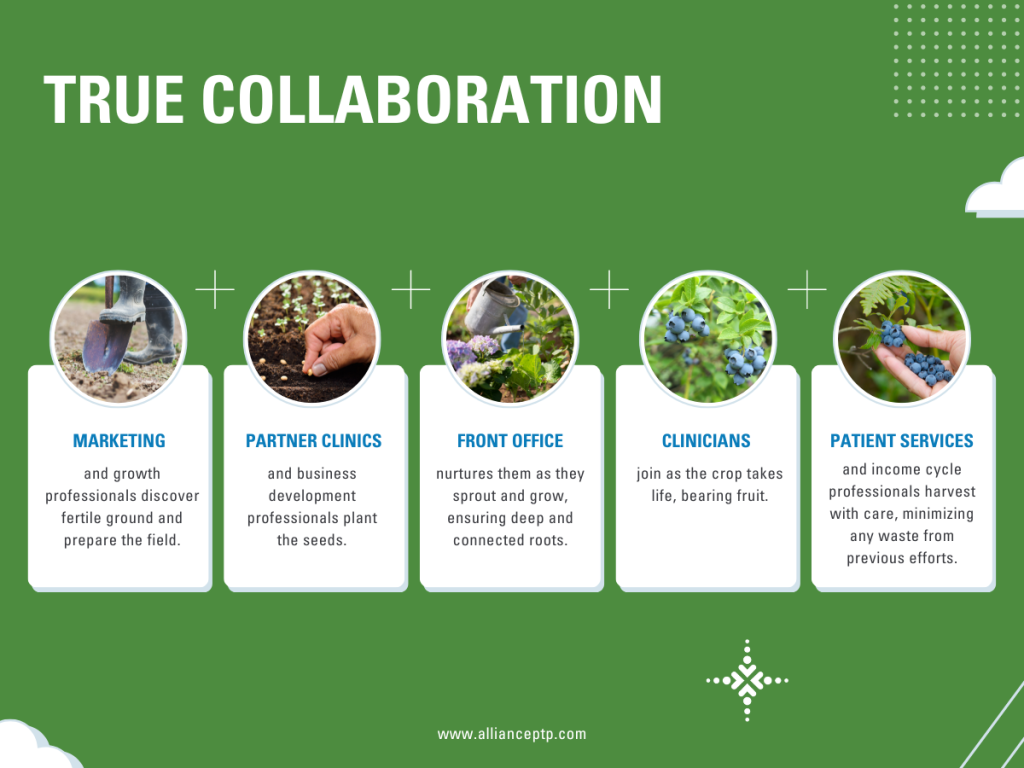
    Marketing and growth professionals discover fertile ground and prepare the field. Partner clinics and business development professionals plant the seeds. The front office nurtures them as they sprout and grow, ensuring deep and connected roots. Clinicians join in as the crop takes life, bearing fruit. Patient services and income cycle professionals harvest with care, minimizing any waste from previous efforts.

    Boss Blog: True Collaboration Boss Blog

    Every part is dependent on each other. You can’t sow in a barren field, and you can’t harvest if no one planted. If there’s no one to harvest it, then the growth will rot. It’s not just about doing your job expertly, it’s about setting up success for everyone in the process after you.

    In physical therapy, the dedication of the credentialing team and attention to detail by the front office can both contribute to the eventual success of the income cycle. The efforts of CIV can help ensure smooth care delivery without unnecessary interruptions for the clinician. Success is a team effort and is woven into the big picture that we’re all in this together.

    When you truly collaborate, you don’t need your hand on every plow and you don’t have to water every plant yourself. Trust that your team is doing their best work alongside you. It leverages your strengths and mitigates your weaknesses.

    There are very few things that sound as fun as a Taco Bell Dorito Loco, so you need to look for those opportunities along your journey. You’ll find in the long run, the fleeting energy of being a superstar is empty in comparison to the fulfillment of collaborating as part of a team.

  • Boss Blog: Stages of Play

    Boss Blog: Stages of Play

    Sometimes you get gifts you want, and sometimes you get gifts you need. During my time at the University of Illinois at Chicago, I had no interest in the topic of pediatrics. However, the cohort of professors at the time were some of the most elite minds in the nation regarding pediatric physical therapy. Notably, Dr. Suzann Campbell, renowned author of Physical Therapy for Children.1

    With no small effort, I absorbed enough information about pediatrics from their studies for me to graduate, successfully pass my boards and even recognize a few more common conditions. One impactful aspect was the discussion on social development, which included Mildred Parten’s Stages of Play.   

    In her 1929 doctoral dissertation, Parten described six distinct types of play that she observed in children as they developed between birth and five years of age.2 These include:  

    • Unoccupied Play – Gaining basic awareness of their body parts and movements.  
    • Solitary Play – Playing alone with no interest in others.  
    • Onlooker – Watching others play.  
    • Parallel Play – Playing in proximity of others, but not WITH them.  
    • Associate Play – Playing with interaction that does not require cooperation (e.g. playground). 
    • Cooperative Play – Playing in a way that is engaged with both the activity and the other participants.  

    I’m sure I passed through each of these stages in my first five years or so of life. However, what I can’t explain is why in the following 45 years, I’ve chosen to repeat the process over and over. While cooperative play is the most fulfilling, pitfalls exist that fuel self-reliance and drag me back down the Stages of Play.

    Physical therapy is a collaborative game where everyone must play together for anyone to win. This includes staying current with the best evidence to promoting the profession to advocating for fair reimbursement or maintaining maximum compliance. If just one of these factors mattered, it may be feasible to survive at the “associate play” stage where everyone agrees to “play nice” in the same sandbox. The way to have fun playing the game is to know that you can be in your role and someone else is in theirs, and we are all contributing our gifts, whether wanted or needed, in a collaborative way.

    Alliance Physical Therapy Partners are experts in areas such as credentialing, compliance, operations, income cycle management, clinical excellence, and marketing, offering solutions to your challenges. If you want to have fun playing the game and focusing on your gifts, consider partnering with us.

    1. Campbell, et. al. (2011) Physical Therapy for Children. Saunders. ISBN 978-1416066262  
    2. Hughes, Fergus P. (2009). Children, Play and Development. SAGE. pp. 100–103. ISBN 978-1-4129-6769-3. 
  • Boss Blog: Lessons from Pizza

    Boss Blog: Lessons from Pizza

    When I moved to West Michigan from the south side of Chicago, it seemed like an unwritten rule for locals to share recommendations about must-try pizza places. Out of politeness and a desire to get acquainted with the neighborhood, there was a sense of obligation to venture out and later provide feedback on whether the pizza lived up to expectations. (Spoiler alert: It did not.) 

    We tried all the places. Some came close, like the one with the perfect crust, but not nearly enough sauce. Another spot offered pizza that resembled small loaves of bread with ingredients sparingly sprinkled on top. And then there was the puzzling choice of arbitrarily adding pineapple as a topping, justified by the server explaining “most people order pineapple with ham.” We all make mistakes.  

    In each chapter of my quest for the perfect pizza, well-intentioned individuals steered me toward professional pizza makers who undoubtedly meant no harm to me or my family. But if that were the case, why was the pizza disappointing? I settled on the thought that they may never have had great pizza. 

    As I grow older, it becomes easier to identify and reflect upon my mistakes. I have made plenty of them, but the earliest ones are the most vivid in my memory. I can now share wisdom through anecdotes based on ridiculous events from my past, partly (even mostly) because they are in the past. 

    It is worth noting that I did not necessarily view those experiences as mistakes when they occurred. This includes clinical decision-making, interactions with coworkers, and choices about professional development among other topics. The biggest challenge most days is recognizing, admitting and actively addressing the mistakes I am currently making.  

    To learn from a mistake, two elements are essential. First, it requires humility to acknowledge that the way you approach a task may not be the best, even if the result is close to your expectations. Arrogance and an inflated sense of excellence were barriers to my personal and professional growth. Is your treatment approach good, but getting stale? What can you add (or remove) to improve it? Like a pizza with an excellent crust, the tendency is strong to bask in praise for the positive without acknowledging the need for more sauce.  

    The second element is perspective. Feedback from individuals whose experiences mirror our own solidifies local biases. Sometimes we treat with our dogma. Sometimes we take another spine course because we love treating backs when we might actually need a shoulder course to round out our skill set. We assume approaches based on similar previous interactions. Are we avoiding conversations with peers or coworkers because they’ve always been avoided? We commit the sacrilege of putting pineapple on pizza because it’s what people have always done in a particular place. 

    Embracing humility and seeking diverse perspectives are not only in the context of good pizza but also in life. We must invite criticism and seek ways to improve by engaging with individuals whose backgrounds, experiences and ways of life differ from ours. A partner like Alliance PTP can connect you with people doing exceptional work and who care deeply about the quality of the product they deliver. 

    Try new things. Trust the feedback of others. Refine your recipe. Don’t just be comparatively good in terms of local competition. Deliver something genuinely exceptional.

  • Boss Blog: Navigating the Negativity

    Boss Blog: Navigating the Negativity

    “The Best Jobs of the 2000s”—a title that appeared in virtually every magazine throughout the 1990s. At this time, email was nonexistent, and Google was still a decade away from going public. However, everyone knew PT was the profession of choice in the new millennium.

    In the early 2000s, information started flowing electronically. By 2010, it became a commonplace to “Google” something. Now, access to information has almost completed its transformation in delivery flow. We used to “pull” information, or actively find and select it. But now, it’s “pushed” to us, compiled based on what the algorithm believes will keep us reading. Make no mistake. It isn’t based on what we’d like to hear or what’s in our best interest. It’s based on what will keep us engaged.

    When I was choosing a career, doomscrolling wasn’t even a concept. The closest we had was the National Enquirer, which had nothing about PT. Tabloids kept people’s attention through a constant flow of the strange and negative. Now, the availability of negativity has reached an all-time high.

    Here are some articles that have recently been sent through my feeds or email:

    • New Report Shows Thousands of PTs Left the Workforce in 2021 (APTQI).
    • Physical Therapy Burnout Destroying Our Profession (coremedicalgroup.com)?
    • 28% of Physicians Would Not Choose Medicine Again (Medscape).
    • 3.4% Conversion Factor Reduction and Its Impact on Payments (APTA).

    These are all real, important to consider, and require action where we can take it. Oddly enough, my inbox is not flooded with these statistics:

    • The Bureau of Labor Statistics projects a 23% growth rate for PTs between 2022 and 2032, much higher than the rate for all occupations (BLS Outlook Handbook).
    • Physical Therapists have the 7th highest job satisfaction of all physician subspecialties at 4.3/5 (Medscape Compensation Report).
    • Job security is strong going forward as PT School Admissions are flat to declining (PTCAS). This creates inherent demand, particularly for therapists willing to work in a rural setting.
    • Primary Care Physicians see an average of 22.8 patients per day (Elation Health) while Chiropractors see up to 50 patients per day (Parker University). Physical Therapists typically see 10-15 patients per day (WebPT), allowing more time with each patient than other professions.

    The news that is pushed to you is typically not good news. But it is not the ONLY news. It is so easy to get discouraged when we are inundated with the negative.

    Everything positive about PT in the 1990s remains just as relevant today, if not more so. Stay involved and aware. Understand the negatives, pitfalls, reimbursement challenges, and barriers to access. Fight against them.

    I encourage you to seek out the positives. Know that you are doing what you worked so hard for, in the unique way you do it. Take comfort in the fact that you’re in a profession that values excellence, quality, and measurable results. “Pull” the good and positive things back into your conversations and let yourself feel good about the value you bring every day. Stop the professional doomscrolling and take ownership of your algorithm.

  • Boss Blog: Burnout

    Boss Blog: Burnout

    Forty years before Antonio Banderas and Sir Anthony Hopkins teamed up in 1998’s “The Mask of Zorro”, Guy Williams portrayed the masked swordsman in a television series.  I wasn’t alive then, but when I was spending summers with my grandmother, reruns were the gift that kept on giving. 

    In modern movies, suspense builds as the camera flashes from the ongoing action back to the digital timer on the bomb ticking toward zero.  The television show was set in 1820’s California, and there was no electronically enhanced suspense.  

    The villain would secure the hostages, set up a powder keg, and then light the end of a long fuse.  The fuse racing along its path towards its explosive end, while Zorro found himself entangled in battle. With moments to spare, the camera would cut to the shining sword of the masked man slicing elegantly through the fuse which, in turn, ended its intense journey with a burnout.  

    So many articles about burnout exist.  I assume none of the others start with Zorro.  They give you excellent advice about setting boundaries and practicing self-care.  They suggest you take breaks, seek support, and invest in your free time.  These are all great ideas, even when you aren’t feeling burnt out.  

    But computers don’t burn out.  They haven’t felt it.  I have. 

    I can tell you that I’ve worked 70-hour weeks where I was completely invested and energized.  I can also tell you I’ve spent months in other roles not wanting to get out of bed, barely putting in my 40 hours, and still dreading the next shift. I don’t have a top five list for mitigating burnout.  I have one item to share with you: Burnout is caused when you lose your connection to purpose. 

    Like a fuse racing along its path, you do the work.  You march on toward the eventual explosion of good things that the journey promised.  And then somehow, the connection is severed, and you fizzle out.  There is nothing self-care, support, or reorganization of boundaries can overcome when feeling the helplessness of not knowing what you’re doing or why you’re doing it. 

    Alliance Physical Therapy Partners is committed to improving the therapeutic partnership between patients and clinicians. They are committed to proving value in the delivery of physical therapy.  These goals are simple, concrete, real, and meaningful. I can connect to them, and they’re refreshing. Working without a purpose is exhausting, and burnout is inevitable. Connecting the work you do to a purpose that you believe in is the one factor that can overcome burning out. 

    Please take all the other suggestions to heart.  Take care of yourself, talk with coworkers, and get enough sleep.  Those are excellent ideas regardless of the risk of burnout.  Please, honestly explore why you are doing what you’re doing and see if it connects with your purpose.  If it does not, then explore how it can.  Do what you want to be doing along with what you must do. Connect that flame with the powder keg of your potential and let that spark of your work fulfill its role and have maximum impact on your work life. 

  • Boss Blog: Leadership Lessons from the Colosseum

    Boss Blog: Leadership Lessons from the Colosseum

    Leadership lessons can often emerge from unexpected sources. Ridley Scott’s Gladiator not only offers cinematic brilliance but encapsulates timeless principles of leadership and unity — values that resonate deeply at Alliance Physical Therapy Partners.

    In one iconic scene, Russel Crowe’s Maximus, is led into the Colosseum in Rome. He and his companions are slated to be massacred in a reenactment of the battle of Carthage.  While waiting, Maximus assesses the numbers of his team and evaluates each skillset. He asks who has served in the army and identifies those who have served with him before. 

    Although the upcoming challenges are completely unknown, as the tension builds, he boldly states, “Whatever comes out of those gates, we’ve got a better chance of survival if we work together.  Do you understand?  If we stay together, we survive.” 

    Archers in armored chariots accompany warriors with swords and spears circling the outnumbered band of gladiators.  Maximus reminds them,“ Stay together.”  He tells them “Stay as one! Hold! Hold! As one!” Their unity becoming their greatest strength. 

    Whether the gladiators had military training or not, they contributed with the skills they had under the direction of someone with a plan.  They walked away from the reenactment victorious, and gladiators who were expected to die lived to fight another day.  

    Maximus’ leadership showcased in that three-minute example reminded me of how truly great leaders lead.  He didn’t try to do it all himself; he asked questions, took inventory of his team, assessed strengths. Then, he formulated a plan and communicated it effectively. His overarching focus and message was clear: achieving success through unity.  This emphasis on collective achievement aligns seamlessly with Alliance Physical Therapy Partners’ commitment to leadership development. By investing in strong leaders through our CORE program, we are also investing in team unity. A great exmaple of this is. The CORE program, one of our a multi-day events, oriented toward teaching therapists skills they need to become effective clinic directors. This program also gives leaders at every level a chance to meet in person and assess and discuss performance in comparison to the care model that is expected, ensuring alignment with our organization’s mission.   

    Navigating challenges on your own can be daunting.  Great leaders keep the message simple, keeping everyone together, moving toward a common goal. By building teams that empower their employees to leverage their strengths, great leaders create an environment where everyone feels safe together, thrives, and collectively moves towards a common goal.  Through our CORE program and mentorship opportunities, Alliance Physical Therapy Partners is building a strong foundation of leaders for years to come.

When Was Your Appointment?

We recently changed bill pay providers. Please click the button for the date of your appointment to be directed to the correct online payment portal.